SOAP, BIRP, DAP, and PIE organize a note in different ways. For a teaching exercise, that difference gives students a useful task: decide which parts of a fictional conversation belong in the record, which are interpretations, and which details the evidence does not support.
This guide focuses on documentation practice after a simulated conversation. A training record and a clinical record serve different purposes. An agency or program determines its actual documentation format and requirements.
Four structures to compare
| Format | Sections | Teaching question |
|---|---|---|
| SOAP | Subjective, Objective, Assessment, Plan | Have reported experience, observation, interpretation, and next steps been distinguished? |
| BIRP | Behavior, Intervention, Response, Plan | Can the learner connect an action with the response that followed? |
| DAP | Data, Assessment, Plan | Does the interpretation follow from the recorded data? |
| PIE | Problem, Intervention, Evaluation | Does the record explain what was addressed, what was done, and what can be evaluated? |
Use your program's conventions for each section. A format name does not establish that a note meets an institution's requirements, and a complete-looking template can still contain unsupported information.
Work from a fictional exchange
Suppose a simulated counterpart says, “I have been missing lectures because I worry about speaking in front of everyone.” The learner asks when this happens and checks a summary of the concern.
A documentation drill can ask students to identify three things: the counterpart's report, the learner's action, and the response to that action. It can then ask what they cannot conclude from the exchange.
In a text exercise, students should not invent observed posture, facial expression, or breathing. A fictional transcript also does not justify a diagnosis unless the course task and qualified review explicitly establish the necessary context.
Compare two formats using the same evidence
Give the cohort the same transcript and ask for a short SOAP-style or BIRP-style training note. Then compare how the structures distribute the information.
The goal is not to find the template that produces the longest answer. It is to preserve the relevant evidence while separating report, action, interpretation, and follow-up. Ask learners to point back to the transcript for each factual statement.
Review an AI draft as a draft
If an exercise includes AI-assisted drafting, make verification part of the task. Students should check whether the draft introduces an event that did not occur, turns an inference into a fact, or omits a relevant correction.
Ask them to mark each proposed change and explain why it improves accuracy. That makes the review visible to the instructor. A fluent draft does not establish that the underlying record is correct.
Keep documentation practice connected to the course
For a pilot, choose one conversation objective and one documentation objective. The first might be checking a summary; the second might be distinguishing reported information from interpretation. Review them separately, even when they come from the same attempt.
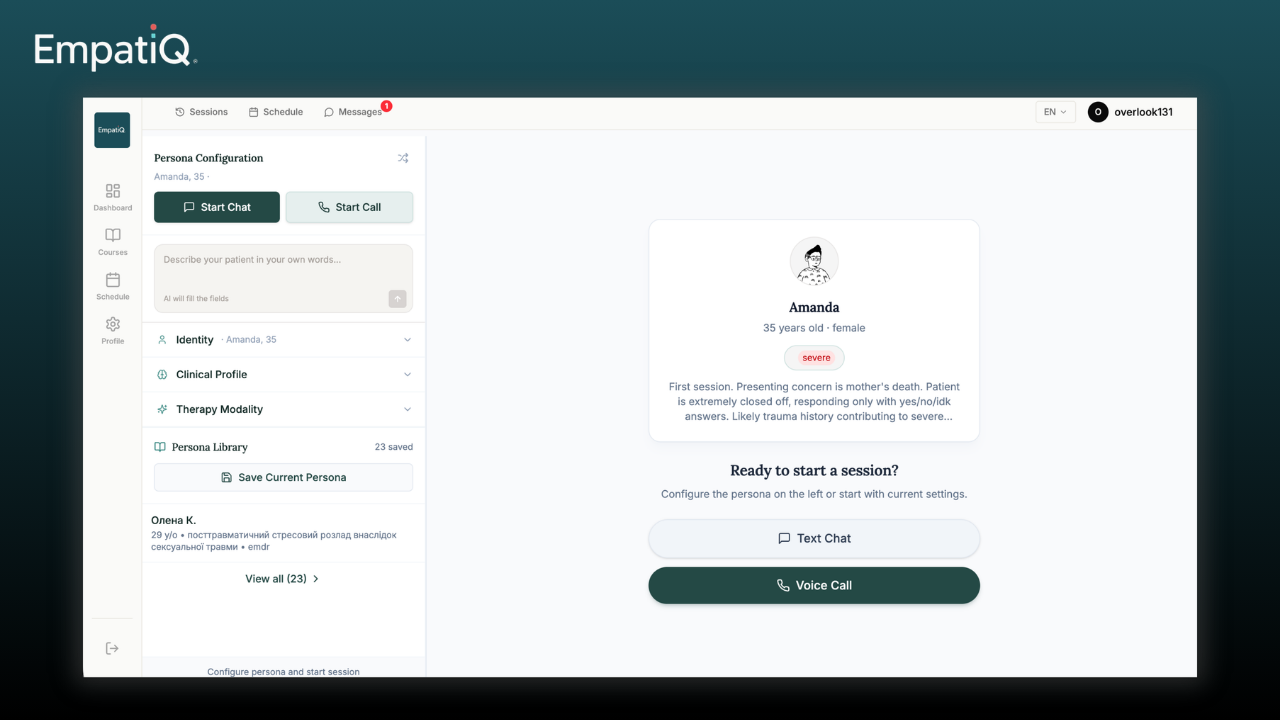
EmpatiQ connects learning content, AI conversation practice, feedback, and records of completed training. Professional tools are a separate part of the platform's offering; the teaching task here is to review the evidence from an exercise.
Read the faculty review template, or explore psychology program training.