
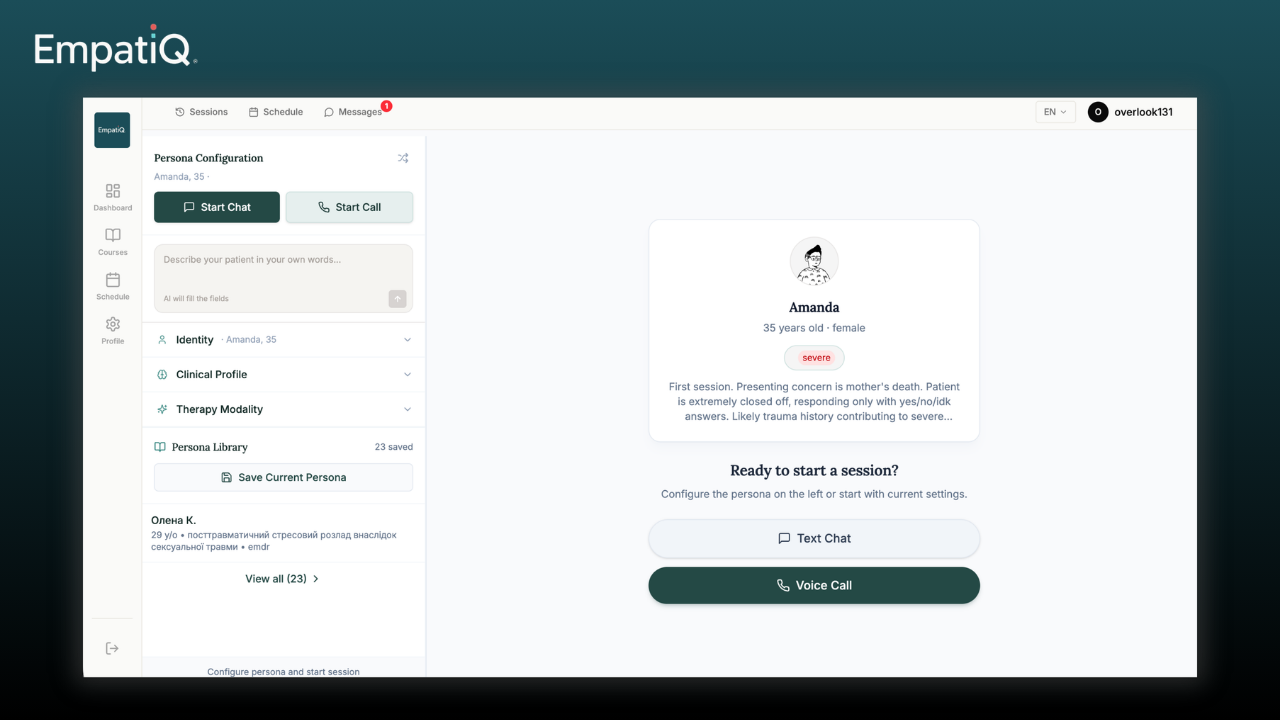
An AI counterpart should give learners a conversation they can respond to, rather than a fixed series of agreeable replies. In EmpatiQ, simulated emotional and behavioral state helps shape what a character says and reveals as an exercise unfolds.
That state belongs to the fictional counterpart. It is a model for generating training behavior, not a measurement of a real person's feelings or a clinical finding about the learner.
A reply carries context
The same question can lead to different responses depending on the character's history, the scenario, and what has already happened in the conversation. A counterpart may disclose more information, keep a concern private, or challenge a learner's assumption.
For course authors, the point is to give the learner a reason to listen and adapt. Cooperation should not be the automatic result of including a preferred keyword. The exercise should present meaningful decisions within its learning objective.
Emotion, trust, and behavior are related teaching tools
The homepage describes an engine that represents emotional state, intensity, and change, drawing on Plutchik's framework. It also distinguishes personal, procedural, and tactical trust in the simulated interaction. These are design choices that help shape a counterpart's behavior.
The scientific ideas are inspirations, not proof that the implementation reproduces human emotion. Plutchik's account of emotion is one foundation readers can explore. EmpatiQ's own behavioral consistency, alignment with expert judgment, and transfer to practice need evaluation in the contexts where the system is used.
Design a contrast the learner can review
Consider a fictional interview in which the counterpart is uncertain about how the conversation will be used. One learner moves directly to questions. Another first explains the purpose and checks the counterpart's understanding.
An instructor can compare the choices and the exchanges that followed. The teaching question is what the learner did and why it fit the task. A simulated change in trust is supporting context; it is not sufficient evidence that the learner demonstrated a professional skill.
Evaluate the scenario before expanding it
Ask subject-matter reviewers to try the exercise with several approaches. Does the counterpart remain consistent with the brief? Does it reveal information at plausible points? Does the feedback cite the exchange accurately? Does the task elicit the intended skill?
Include counterexamples. A blunt but appropriate clarification should not fail merely because it lacks an empathy phrase. A polished sentence should not earn praise if it ignores the counterpart's correction.
Use findings to revise the scenario and rubric. Keep the version of the exercise visible when comparing attempts so a change in the counterpart is not mistaken for a change in learner performance.
Connect the model to the teaching loop
EmpatiQ links course content, AI conversation practice, and review records. The model gives a learner something to respond to. The debrief and faculty review turn that exchange into a learning opportunity.
Explore the research section, university programs, and the guide to AI-simulated patient practice.